DevSecOps : Netflix Clone CI-CD with Monitoring | Email
𝑪𝒍𝒐𝒖𝒅 𝒂𝒏𝒅 𝑫𝒆𝒗𝑶𝒑𝒔 𝑻𝒆𝒄𝒉 𝑪𝒐𝒎𝒎𝒖𝒏𝒊𝒕𝒚 || 𝑷𝒓𝒐𝑫𝒆𝒗𝑶𝒑𝒔𝑮𝒖𝒚 🤖 https://t.me/prodevopsguy 👋 Hi there! We are ProDevOpsGuy, a passionate DevOps enthusiast Tech Community with a strong belief in the power of automation and collaboration to drive innovation. 🚀 I thrive in bridging the gap between development and operations, creating seamless and efficient software delivery pipelines. My journey in the world of DevOps has allowed me to blend my technical skills with a knack for problem-solving, enabling me to contribute effectively to agile and dynamic environments. 💡 With a keen interest in continuous integration, continuous delivery (CI/CD), containerization, and orchestration, I've had the privilege to explore cutting-edge technologies like Docker, Kubernetes, Jenkins, and Ansible. I find joy in designing scalable and resilient infrastructures that enable teams to deploy applications faster and with greater confidence. 🌐 Beyond the tech realm, I'm an advocate for DevOps culture, emphasizing collaboration, communication, and a relentless pursuit of improvement. I'm always eager to connect with fellow professionals, exchange insights, and explore opportunities to collaborate on exciting projects. 📚 When I'm not tinkering with the latest DevOps tools, you can find me indulging in books on technology trends, hiking to rejuvenate, and occasionally experimenting with new coding challenges. 🌟 Let's connect! Whether you're looking to discuss DevOps methodologies, explore partnership opportunities, or simply share experiences, feel free to reach out. I'm excited to be part of the DevOps journey, driving excellence together.
Project Overview:-
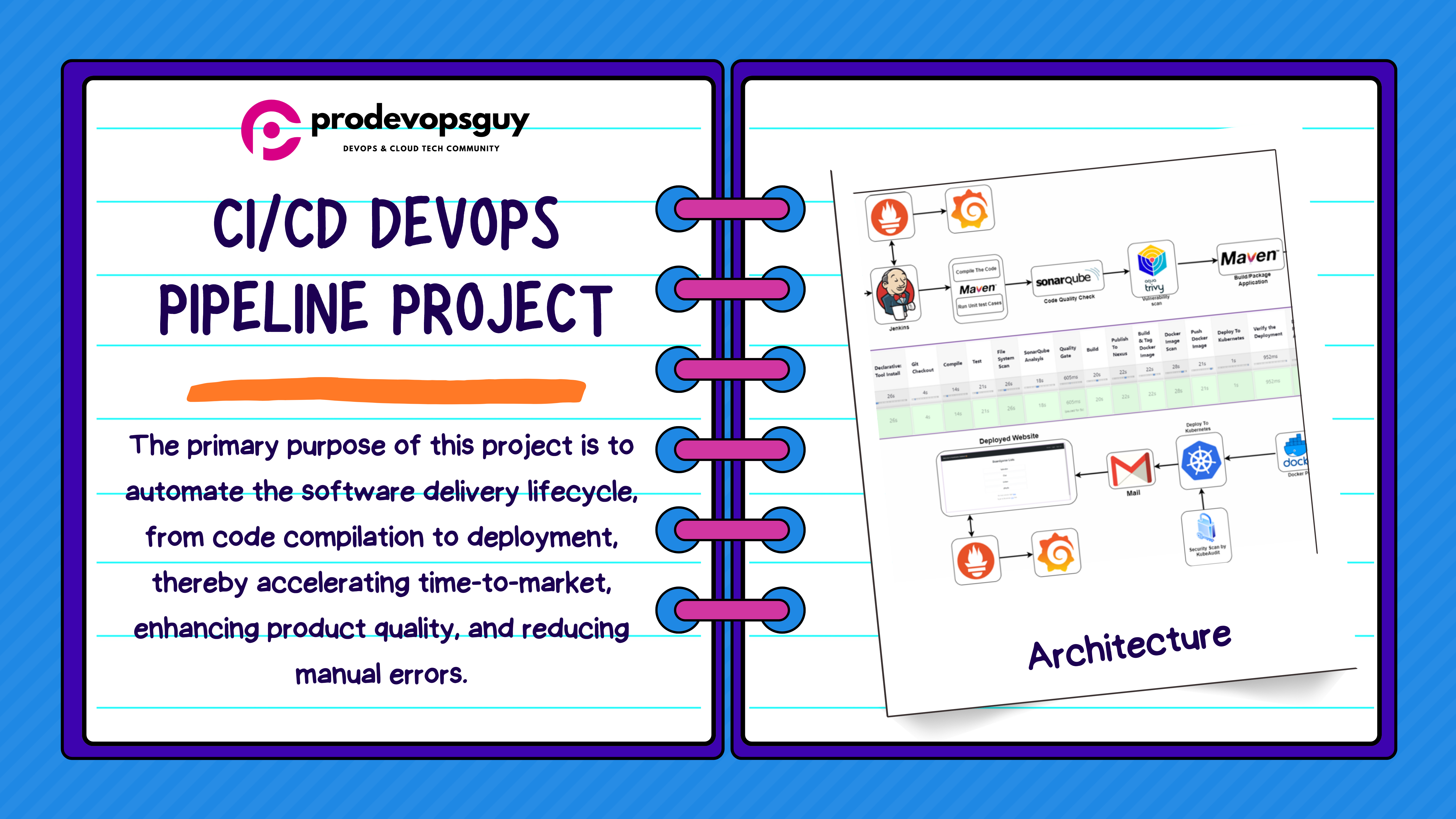
- We will be deploying a Netflix clone. We will be using Jenkins as a CICD tool and deploying our application on a Docker container and Kubernetes Cluster and we will monitor the Jenkins and Kubernetes metrics using Grafana, Prometheus and Node exporter. I Hope this detailed blog is useful.
Project Steps:-
Step 1 — Launch an Ubuntu(22.04) T2 Large Instance
Step 2 — Install Jenkins, Docker and Trivy. Create a Sonarqube Container using Docker.
Step 3 — Create a TMDB API Key.
Step 4 — Install Prometheus and Grafana On the new Server.
Step 5 — Install the Prometheus Plugin and Integrate it with the Prometheus server.
Step 6 — Email Integration With Jenkins and Plugin setup.
Step 7 — Install Plugins like JDK, Sonarqube Scanner, Nodejs, and OWASP Dependency Check.
Step 8 — Create a Pipeline Project in Jenkins using a Declarative Pipeline
Step 9 — Install OWASP Dependency Check Plugins
Step 10 — Docker Image Build and Push
Step 11 — Deploy the image using Docker
Step 12 — Kubernetes master and slave setup on Ubuntu (20.04)
Step 13 — Access the Netflix app on the Browser.
Step 14 — Terminate the AWS EC2 Instances.
Step 1: Launch an Ubuntu(22.04) T2 Large Instance
Launch an Ubuntu(22.04) T2 Large Instance
Launch an AWS T2 Large Instance. Use the image as Ubuntu. You can create a new key pair or use an existing one. Enable HTTP and HTTPS settings in the Security Group and open all ports (not best case to open all ports but just for learning purposes it’s okay).

Step 2 : Install Jenkins, Docker and Trivy. Create a Sonarqube Container using Docker.
Install Jenkins, Docker and Trivy
2A — To Install Jenkins
Connect to your console, and enter these commands to Install Jenkins
vi jenkins.sh #make sure run in Root (or) add at userdata while ec2 launch
#!/bin/bash
sudo apt update -y
#sudo apt upgrade -y
wget -O - https://packages.adoptium.net/artifactory/api/gpg/key/public | tee /etc/apt/keyrings/adoptium.asc
echo "deb [signed-by=/etc/apt/keyrings/adoptium.asc] https://packages.adoptium.net/artifactory/deb $(awk -F= '/^VERSION_CODENAME/{print$2}' /etc/os-release) main" | tee /etc/apt/sources.list.d/adoptium.list
sudo apt update -y
sudo apt install temurin-17-jdk -y
/usr/bin/java --version
curl -fsSL https://pkg.jenkins.io/debian-stable/jenkins.io-2023.key | sudo tee \
                  /usr/share/keyrings/jenkins-keyring.asc > /dev/null
echo deb [signed-by=/usr/share/keyrings/jenkins-keyring.asc] \
                  https://pkg.jenkins.io/debian-stable binary/ | sudo tee \
                              /etc/apt/sources.list.d/jenkins.list > /dev/null
sudo apt-get update -y
sudo apt-get install jenkins -y
sudo systemctl start jenkins
sudo systemctl status jenkins
sudo chmod 777 jenkins.sh
./jenkins.sh    # this will installl jenkins
Once Jenkins is installed, you will need to go to your AWS EC2 Security Group and open Inbound Port 8080, since Jenkins works on Port 8080.
Now, grab your Public IP Address
<EC2 Public IP Address:8080>
sudo cat /var/lib/jenkins/secrets/initialAdminPassword
- 2B — Install Docker
sudo apt-get update
sudo apt-get install docker.io -y
sudo usermod -aG docker $USER   #my case is ubuntu
newgrp docker
sudo chmod 777 /var/run/docker.sock
``
- After the docker installation, we create a sonarqube container (Remember to add 9000 ports in the security group).
```bash
docker run -d --name sonar -p 9000:9000 sonarqube:lts-community
- 2C — Install Trivy
vi trivy.sh
sudo apt-get install wget apt-transport-https gnupg lsb-release -y
wget -qO - https://aquasecurity.github.io/trivy-repo/deb/public.key | gpg --dearmor | sudo tee /usr/share/keyrings/trivy.gpg > /dev/null
echo "deb [signed-by=/usr/share/keyrings/trivy.gpg] https://aquasecurity.github.io/trivy-repo/deb $(lsb_release -sc) main" | sudo tee -a /etc/apt/sources.list.d/trivy.list
sudo apt-get update
sudo apt-get install trivy -y
Step 3: Create a TMDB API Key
Next, we will create a TMDB API key
Open a new tab in the Browser and search for TMDB
Click on the first result, you will see this page
Click on the Login on the top right. You will get this page.
You need to create an account here. click on click here. I have an account that’s why I added my details there.
once you create an account you will see this page.
Let’s create an API key, By clicking on your profile and clicking settings.
Now click on API from the left side panel.
Now click on create
Click on Developer
Now you have to accept the terms and conditions.
Provide basic details
Click on submit and you will get your API key.
Step 4 : Install Prometheus and Grafana On the new Server.
Install Prometheus and Grafana On the new Server
First of all, let’s create a dedicated Linux user sometimes called a system account for Prometheus. Having individual users for each service serves two main purposes:
It is a security measure to reduce the impact in case of an incident with the service.
It simplifies administration as it becomes easier to track down what resources belong to which service.
To create a system user or system account, run the following command:
sudo useradd \
    --system \
    --no-create-home \
    --shell /bin/false prometheus
— system — Will create a system account.
— no-create-home — We don’t need a home directory for Prometheus or any other system accounts in our case.
— shell /bin/false — It prevents logging in as a Prometheus user.
Prometheus — Will create a Prometheus user and a group with the same name.
You can use the curl or wget command to download Prometheus.
wget https://github.com/prometheus/prometheus/releases/download/v2.47.1/prometheus-2.47.1.linux-amd64.tar.gz
- Then, we need to extract all Prometheus files from the archive.
tar -xvf prometheus-2.47.1.linux-amd64.tar.gz
- Usually, you would have a disk mounted to the data directory. For this tutorial, I will simply create a /data directory. Also, you need a folder for Prometheus configuration files.
sudo mkdir -p /data /etc/prometheus
- Now, let’s change the directory to Prometheus and move some files.
cd prometheus-2.47.1.linux-amd64/
- First of all, let’s move the Prometheus binary and a promtool to the /usr/local/bin/. promtool is used to check configuration files and Prometheus rules.
sudo mv prometheus promtool /usr/local/bin/
- Optionally, we can move console libraries to the Prometheus configuration directory. Console templates allow for the creation of arbitrary consoles using the Go templating language. You don’t need to worry about it if you’re just getting started.
sudo mv consoles/ console_libraries/ /etc/prometheus/
- Finally, let’s move the example of the main Prometheus configuration file.
sudo mv prometheus.yml /etc/prometheus/prometheus.yml
- To avoid permission issues, you need to set the correct ownership for the /etc/prometheus/ and data directory.
sudo chown -R prometheus:prometheus /etc/prometheus/ /data/
- You can delete the archive and a Prometheus folder when you are done.
cd ..
rm -rf prometheus-2.47.1.linux-amd64.tar.gz
We’re going to use some of these options in the service definition.
We’re going to use Systemd, which is a system and service manager for Linux operating systems. For that, we need to create a Systemd unit configuration file.
sudo vim /etc/systemd/system/prometheus.service
- Prometheus.service
[Unit]
Description=Prometheus
Wants=network-online.target
After=network-online.target
StartLimitIntervalSec=500
StartLimitBurst=5[Service]
User=prometheus
Group=prometheus
Type=simple
Restart=on-failure
RestartSec=5s
ExecStart=/usr/local/bin/prometheus \
  --config.file=/etc/prometheus/prometheus.yml \
  --storage.tsdb.path=/data \
  --web.console.templates=/etc/prometheus/consoles \
  --web.console.libraries=/etc/prometheus/console_libraries \
  --web.listen-address=0.0.0.0:9090 \
  --web.enable-lifecycle[Install]
WantedBy=multi-user.target
Let’s go over a few of the most important options related to Systemd and Prometheus. Restart — Configures whether the service shall be restarted when the service process exits, is killed, or a timeout is reached. RestartSec — Configures the time to sleep before restarting a service. User and Group — Are Linux user and a group to start a Prometheus process. — config.file=/etc/prometheus/prometheus.yml — Path to the main Prometheus configuration file. — storage.tsdb.path=/data — Location to store Prometheus data. — web.listen-address=0.0.0.0:9090 — Configure to listen on all network interfaces. In some situations, you may have a proxy such as nginx to redirect requests to Prometheus. In that case, you would configure Prometheus to listen only on localhost. — web.enable-lifecycle — Allows to manage Prometheus, for example, to reload configuration without restarting the service.
To automatically start the Prometheus after reboot, run enable.
sudo systemctl enable prometheus
sudo systemctl start prometheus
sudo systemctl status Prometheus
- Suppose you encounter any issues with Prometheus or are unable to start it. The easiest way to find the problem is to use the journalctl command and search for errors.
journalctl -u prometheus -f --no-pager
- Now we can try to access it via the browser. I’m going to be using the IP address of the Ubuntu server. You need to append port 9090 to the IP.
<public-ip:9090>
If you go to targets, you should see only one — Prometheus target. It scrapes itself every 15 seconds by default.
Install Node Exporter on Ubuntu 22.04
Next, we’re going to set up and configure Node Exporter to collect Linux system metrics like CPU load and disk I/O. Node Exporter will expose these as Prometheus-style metrics. Since the installation process is very similar, I’m not going to cover as deep as Prometheus.
First, let’s create a system user for Node Exporter by running the following command:
sudo useradd \
    --system \
    --no-create-home \
    --shell /bin/false node_exporter
- Use the wget command to download the binary.
wget https://github.com/prometheus/node_exporter/releases/download/v1.6.1/node_exporter-1.6.1.linux-amd64.tar.gz
- Extract the node exporter from the archive.
tar -xvf node_exporter-1.6.1.linux-amd64.tar.gz
- Move binary to the /usr/local/bin.
sudo mv \
  node_exporter-1.6.1.linux-amd64/node_exporter \
  /usr/local/bin/
- Clean up, and delete node_exporter archive and a folder.
rm -rf node_exporter*
- Next, create a similar systemd unit file.
sudo vim /etc/systemd/system/node_exporter.service
- node_exporter.service
[Unit]
Description=Node Exporter
Wants=network-online.target
After=network-online.target
StartLimitIntervalSec=500
StartLimitBurst=5[Service]
User=node_exporter
Group=node_exporter
Type=simple
Restart=on-failure
RestartSec=5s
ExecStart=/usr/local/bin/node_exporter \
    --collector.logind[Install]
WantedBy=multi-user.target
Replace Prometheus user and group to node_exporter, and update the ExecStart command.
To automatically start the Node Exporter after reboot, enable the service.
sudo systemctl enable node_exporter
sudo systemctl start node_exporter
sudo systemctl status node_exporter
- If you have any issues, check logs with journalctl
journalctl -u node_exporter -f --no-pager
At this point, we have only a single target in our Prometheus. There are many different service discovery mechanisms built into Prometheus. For example, Prometheus can dynamically discover targets in AWS, GCP, and other clouds based on the labels. In the following tutorials, I’ll give you a few examples of deploying Prometheus in a cloud-specific environment. For this tutorial, let’s keep it simple and keep adding static targets. Also, I have a lesson on how to deploy and manage Prometheus in the Kubernetes cluster.
To create a static target, you need to add job_name with static_configs.
sudo vim /etc/prometheus/prometheus.yml
- prometheus.yml
- job_name: node_export
    static_configs:
      - targets: ["localhost:9100"]
By default, Node Exporter will be exposed on port 9100.
Since we enabled lifecycle management via API calls, we can reload the Prometheus config without restarting the service and causing downtime.
Before, restarting check if the config is valid.
promtool check config /etc/prometheus/prometheus.yml
- Then, you can use a POST request to reload the config.
curl -X POST http://localhost:9090/-/reload
- Check the targets section
http://<ip>:9090/targets
Install Grafana on Ubuntu 22.04
To visualize metrics we can use Grafana. There are many different data sources that Grafana supports, one of them is Prometheus.
First, let’s make sure that all the dependencies are installed.
sudo apt-get install -y apt-transport-https software-properties-common
- Next, add the GPG key.
wget -q -O - https://packages.grafana.com/gpg.key | sudo apt-key add -
- Add this repository for stable releases.
echo "deb https://packages.grafana.com/oss/deb stable main" | sudo tee -a /etc/apt/sources.list.d/grafana.list
- After you add the repository, update and install Garafana.
sudo apt-get update
sudo apt-get -y install grafana
- To automatically start the Grafana after reboot, enable the service.
sudo systemctl enable grafana-server
sudo systemctl start grafana-server
sudo systemctl status grafana-server
- Go to http://:3000 and log in to the Grafana using default credentials. The username is admin, and the password is admin as well.
username admin
password admin
To visualize metrics, you need to add a data source first.
Click Add data source and select Prometheus.
For the URL, enter localhost:9090 and click Save and test. You can see Data source is working.
Let’s add Dashboard for a better view
Click on Import Dashboard paste this code 1860 and click on load
Select the Datasource and click on Import
You will see this output
Step 5: Install the Prometheus Plugin and Integrate it with the Prometheus server.
Install the Prometheus Plugin and Integrate it with the Prometheus server
Let’s Monitor JENKINS SYSTEM
Need Jenkins up and running machine
Goto Manage Jenkins → Plugins → Available Plugins
Search for Prometheus and install it
Once that is done you will Prometheus is set to /Prometheus path in system configurations
Nothing to change click on apply and save
To create a static target, you need to add job_name with static_configs. go to the Prometheus server
sudo vim /etc/prometheus/prometheus.yml
- Paste below code
- job_name: 'jenkins'
    metrics_path: '/prometheus'
    static_configs:
      - targets: ['<jenkins-ip>:8080']
- Before, restarting check if the config is valid.
promtool check config /etc/prometheus/prometheus.yml
- Then, you can use a POST request to reload the config.
curl -X POST http://localhost:9090/-/reload
``
- Check the targets section
```bash
http://<ip>:9090/targets
-You will see Jenkins is added to it
Let’s add Dashboard for a better view in Grafana
Click On Dashboard → + symbol → Import Dashboard
Use Id 9964 and click on load
Select the data source and click on Import
Now you will see the Detailed overview of Jenkins
Step 6: Email Integration With Jenkins and Plugin setup.
Email Integration With Jenkins and Plugin Setup
Install Email Extension Plugin in Jenkins
Go to your Gmail and click on your profile
Then click on Manage Your Google Account → click on the security tab on the left side panel you will get this page(provide mail password).
2-step verification should be enabled.
Search for the app in the search bar you will get app passwords like the below image
Click on other and provide your name and click on Generate and copy the password
In the new update, you will get a password like this
Once the plugin is installed in Jenkins, click on manage Jenkins → configure system there under the E-mail Notification section configure the details as shown in the below image
Click on Apply and save.
Click on Manage Jenkins → credentials and add your mail username and generated password
This is to just verify the mail configuration
Now under the Extended E-mail Notification section configure the details as shown in the below images
Click on Apply and save.
post {
     always {
        emailext attachLog: true,
            subject: "'${currentBuild.result}'",
            body: "Project: ${env.JOB_NAME}<br/>" +
                "Build Number: ${env.BUILD_NUMBER}<br/>" +
                "URL: ${env.BUILD_URL}<br/>",
            to: 'rutik@gmail.com',  #change Your mail
            attachmentsPattern: 'trivyfs.txt,trivyimage.txt'
        }
    }
- Next, we will log in to Jenkins and start to configure our Pipeline in Jenkins
Step 7: Install Plugins like JDK, Sonarqube Scanner, Nodejs, and OWASP Dependency Check.
Install Plugins like JDK, Sonarqube Scanner, NodeJs, OWASP Dependency Check
7A — Install Plugin
Goto Manage Jenkins →Plugins → Available Plugins →
Install below plugins
1 → Eclipse Temurin Installer (Install without restart)
2 → SonarQube Scanner (Install without restart)
3 → NodeJs Plugin (Install Without restart)
7B — Configure Java and Nodejs in Global Tool Configuration
Goto Manage Jenkins → Tools → Install JDK(17) and NodeJs(16)→ Click on Apply and Save
7C — Create a Job
create a job as Netflix Name, select pipeline and click on ok.
Step 8 : Create a Pipeline Project in Jenkins using a Declarative Pipeline
Configure Sonar Server in Manage Jenkins
Grab the Public IP Address of your EC2 Instance, Sonarqube works on Port 9000, so:9000. Goto your Sonarqube Server. Click on Administration → Security → Users → Click on Tokens and Update Token → Give it a name → and click on Generate Token
click on update Token
Create a token with a name and generate
copy Token
Goto Jenkins Dashboard → Manage Jenkins → Credentials → Add Secret Text. It should look like this
You will this page once you click on create
Now, go to Dashboard → Manage Jenkins → System and Add like the below image.
Click on Apply and Save
The Configure System option is used in Jenkins to configure different server
Global Tool Configuration is used to configure different tools that we install using Plugins
We will install a sonar scanner in the tools.
In the Sonarqube Dashboard add a quality gate also
Administration → Configuration →Webhooks
Click on Create
Add details
#in url section of quality gate
<http://jenkins-public-ip:8080>/sonarqube-webhook/
- Let’s go to our Pipeline and add the script in our Pipeline Script.
pipeline{
    agent any
    tools{
        jdk 'jdk17'
        nodejs 'node16'
    }
    environment {
        SCANNER_HOME=tool 'sonar-scanner'
    }
    stages {
        stage('clean workspace'){
            steps{
                cleanWs()
            }
        }
        stage('Checkout from Git'){
            steps{
                git branch: 'main', url: 'https://github.com/Aj7Ay/Netflix-clone.git'
            }
        }
        stage("Sonarqube Analysis "){
            steps{
                withSonarQubeEnv('sonar-server') {
                    sh ''' $SCANNER_HOME/bin/sonar-scanner -Dsonar.projectName=Netflix \
                    -Dsonar.projectKey=Netflix '''
                }
            }
        }
        stage("quality gate"){
           steps {
                script {
                    waitForQualityGate abortPipeline: false, credentialsId: 'Sonar-token'
                }
            }
        }
        stage('Install Dependencies') {
            steps {
                sh "npm install"
            }
        }
    }
    post {
     always {
        emailext attachLog: true,
            subject: "'${currentBuild.result}'",
            body: "Project: ${env.JOB_NAME}<br/>" +
                "Build Number: ${env.BUILD_NUMBER}<br/>" +
                "URL: ${env.BUILD_URL}<br/>",
            to: 'rutik@gmail.com',
            attachmentsPattern: 'trivyfs.txt,trivyimage.txt'
        }
    }
}
Click on Build now, you will see the stage view like this
To see the report, you can go to Sonarqube Server and go to Projects.
You can see the report has been generated and the status shows as passed. You can see that there are 3.2k lines it scanned. To see a detailed report, you can go to issues.
Step 9 : Install OWASP Dependency Check Plugins
Install OWASP Dependency Check Plugins
GotoDashboard → Manage Jenkins → Plugins → OWASP Dependency-Check. Click on it and install it without restart.
First, we configured the Plugin and next, we had to configure the Tool
Goto Dashboard → Manage Jenkins → Tools →
Click on Apply and Save here.
Now go configure → Pipeline and add this stage to your pipeline and build.
stage('OWASP FS SCAN') {
            steps {
                dependencyCheck additionalArguments: '--scan ./ --disableYarnAudit --disableNodeAudit', odcInstallation: 'DP-Check'
                dependencyCheckPublisher pattern: '**/dependency-check-report.xml'
            }
        }
        stage('TRIVY FS SCAN') {
            steps {
                sh "trivy fs . > trivyfs.txt"
            }
        }
Step 10 : Docker Image Build and Push
Docker Image Build and Push
We need to install the Docker tool in our system, Goto Dashboard → Manage Plugins → Available plugins → Search for Docker and install these plugins
Docker, Docker Commons, Docker Pipeline, Docker API, docker-build-step
and click on install without restart
Now, goto Dashboard → Manage Jenkins → Tools →
Add DockerHub Username and Password under Global Credentials
Add this stage to Pipeline Script
stage("Docker Build & Push"){
            steps{
                script{
                   withDockerRegistry(credentialsId: 'docker', toolName: 'docker'){
                       sh "docker build --build-arg TMDB_V3_API_KEY=Aj7ay86fe14eca3e76869b92 -t netflix ."
                       sh "docker tag netflix sevenajay/netflix:latest "
                       sh "docker push sevenajay/netflix:latest "
                    }
                }
            }
        }
        stage("TRIVY"){
            steps{
                sh "trivy image sevenajay/netflix:latest > trivyimage.txt"
            }
        }
When you log in to Dockerhub, you will see a new image is created
Now Run the container to see if the game coming up or not by adding the below stage
stage('Deploy to container'){
            steps{
                sh 'docker run -d --name netflix -p 8081:80 sevenajay/netflix:latest'
            }
        }
Step 11 : Deploy the image using Docker
Kubernetes Setup
Connect your machines to Putty or Mobaxtreme
Take-Two Ubuntu 20.04 instances one for k8s master and the other one for worker.
Install Kubectl on Jenkins machine also.
Kubectl is to be installed on Jenkins also
sudo apt update
sudo apt install curl
curl -LO https://dl.k8s.io/release/$(curl -L -s https://dl.k8s.io/release/stable.txt)/bin/linux/amd64/kubectl
sudo install -o root -g root -m 0755 kubectl /usr/local/bin/kubectl
kubectl version --client
- Part 1 — — — — — Master Node — — — — — —
sudo hostnamectl set-hostname K8s-Master
- — — — — — Worker Node — — — — — —
sudo hostnamectl set-hostname K8s-Worker
- Part 2 — — — — — — Both Master & Node — — — — — —
sudo apt-get update
sudo apt-get install -y docker.io
sudo usermod –aG docker Ubuntu
newgrp docker
sudo chmod 777 /var/run/docker.socksudo curl -s https://packages.cloud.google.com/apt/doc/apt-key.gpg | sudo apt-key add -sudo tee /etc/apt/sources.list.d/kubernetes.list <<EOF
deb https://apt.kubernetes.io/ kubernetes-xenial main
EOFsudo apt-get updatesudo apt-get install -y kubelet kubeadm kubectlsudo snap install kube-apiserver
- Part 3 — — — — — — — — Master — — — — — — — -
sudo kubeadm init --pod-network-cidr=10.244.0.0/16
# in case your in root exit from it and run below commands
mkdir -p $HOME/.kube
sudo cp -i /etc/kubernetes/admin.conf $HOME/.kube/config
sudo chown $(id -u):$(id -g) $HOME/.kube/config
kubectl apply -f https://raw.githubusercontent.com/coreos/flannel/master/Documentation/kube-flannel.yml
- — — — — — Worker Node — — — — — —
sudo kubeadm join <master-node-ip>:<master-node-port> --token <token> --discovery-token-ca-cert-hash <hash>
Copy the config file to Jenkins master or the local file manager and save it
copy it and save it in documents or another folder save it as secret-file.tx
Note: create a secret-file.txt in your file explorer save the config in it and use this at the kubernetes credential section.
Install Kubernetes Plugin, Once it’s installed successfully
goto manage Jenkins → manage credentials → Click on Jenkins global → add credentials
Install Node_exporter on both master and worker
Let’s add Node_exporter on Master and Worker to monitor the metrics
First, let’s create a system user for Node Exporter by running the following command:
sudo useradd \
    --system \
    --no-create-home \
    --shell /bin/false node_exporter
- Use the wget command to download the binary.
wget https://github.com/prometheus/node_exporter/releases/download/v1.6.1/node_exporter-1.6.1.linux-amd64.tar.gz
- Extract the node exporter from the archive.
tar -xvf node_exporter-1.6.1.linux-amd64.tar.gz
- Move binary to the /usr/local/bin.
sudo mv \
  node_exporter-1.6.1.linux-amd64/node_exporter \
  /usr/local/bin/
- Clean up, and delete node_exporter archive and a folder.
rm -rf node_exporter*
- Next, create a similar systemd unit file.
sudo vim /etc/systemd/system/node_exporter.service
- node_exporter.service
[Unit]
Description=Node Exporter
Wants=network-online.target
After=network-online.target
StartLimitIntervalSec=500
StartLimitBurst=5[Service]
User=node_exporter
Group=node_exporter
Type=simple
Restart=on-failure
RestartSec=5s
ExecStart=/usr/local/bin/node_exporter \
    --collector.logind[Install]
WantedBy=multi-user.target
Replace Prometheus user and group to node_exporter, and update the ExecStart command.
To automatically start the Node Exporter after reboot, enable the service.
sudo systemctl enable node_exporter
sudo systemctl start node_exporter
sudo systemctl status node_exporter
- If you have any issues, check logs with journalctl
journalctl -u node_exporter -f --no-pager
At this point, we have only a single target in our Prometheus. There are many different service discovery mechanisms built into Prometheus. For example, Prometheus can dynamically discover targets in AWS, GCP, and other clouds based on the labels. In the following tutorials, I’ll give you a few examples of deploying Prometheus in a cloud-specific environment. For this tutorial, let’s keep it simple and keep adding static targets. Also, I have a lesson on how to deploy and manage Prometheus in the Kubernetes cluster.
To create a static target, you need to add job_name with static_configs. Go to the Prometheus server
sudo vim /etc/prometheus/prometheus.yml
- prometheus.yml
- job_name: node_export_masterk8s
    static_configs:
      - targets: ["<master-ip>:9100"]
  - job_name: node_export_workerk8s
    static_configs:
      - targets: ["<worker-ip>:9100"]
By default, Node Exporter will be exposed on port 9100.
Since we enabled lifecycle management via API calls, we can reload the Prometheus config without restarting the service and causing downtime.
Before, restarting check if the config is valid.
promtool check config /etc/prometheus/prometheus.yml
- Then, you can use a POST request to reload the config.
curl -X POST http://localhost:9090/-/reload
- Check the targets section
http://<ip>:9090/targets
- final step to deploy on the Kubernetes cluster
stage('Deploy to kubernets'){
            steps{
                script{
                    dir('Kubernetes') {
                        withKubeConfig(caCertificate: '', clusterName: '', contextName: '', credentialsId: 'k8s', namespace: '', restrictKubeConfigAccess: false, serverUrl: '') {
                                sh 'kubectl apply -f deployment.yml'
                                sh 'kubectl apply -f service.yml'
                        }
                    }
                }
            }
        }
- In the Kubernetes cluster(master) give this command
kubectl get all
kubectl get svc #use anyone
Step 12: Kubernetes master and slave setup on Ubuntu (20.04)
Access from a Web browser with
<public-ip-of-slave:service port>
output:


Step 13: Terminate instances.
If you find this article helpful then you can buy me a coffee.
Follow for more stories like this 😊/ GitHub.